Showing posts with label Concept Car. Show all posts

Bentley AERO ACE Sports Car Concept Next-Gen Speed VI

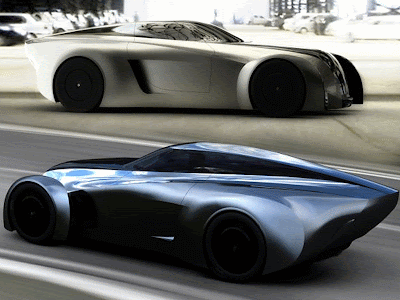
The Bentley Aero Ace Speed VI is the brainchild of auto designer Gabriel Tam and has been inspired by the original Speed 6 driven to victory by the Bentley Boys of the ’20s at Le Mans. The next-generation Speed VI is an overtly sporting vehicle with the raw aggression of a pure blood racer, while retaining the refined elegance of past Bentleys.
Bentley AERO ACE Electric Sports Car Concept Next-Gen Speed VI
The design was inspired to signify the raw aggression of a sporting vehicle, while paying close attention to the aerodynamic properties of each element of the vehicle. The adjustable aerofoil / spoiler feature double wishbone suspension to maximize the efficiency.
Bentley AERO ACE Electric Sports Car Concept Next-Gen Speed VI
Close attention during the designing period to refine the aerodynamic properties of the vehicle has resulted in enhanced efficiency and increased speed. Additionally, a double wishbone suspension has been incorporated within the adjustable spoiler to further better its efficiency.
Bentley AERO ACE Electric Sports Car Concept Next-Gen Speed VI
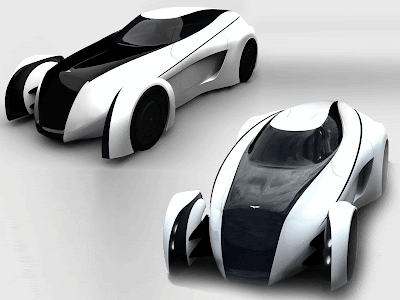
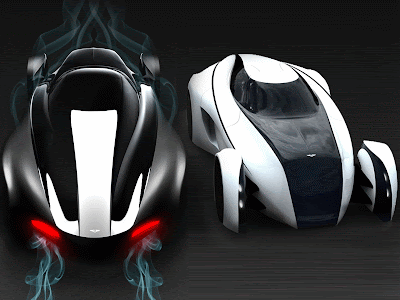
The twin rear heat exhaust-ducts of this zero-emission concept car are fed by the air intake used to keep electric motors cool. Electric motors are located towards the rear of the vehicle, while the battery cells are located towards the front in an even arrangement to balance the weight. The electric motor cooling system features air intake and incorporates diffusers that help air flow to create down-force.
 
 
Bentley AERO ACE Electric Sports Car Concept Next-Gen Speed VI
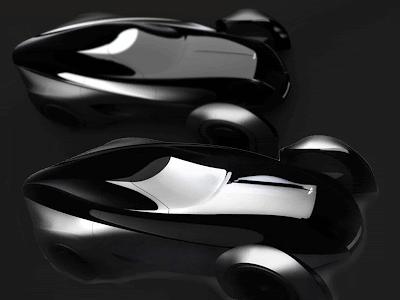
The wheels are semi enclosed that improves aerodynamics, while the 1+1 seating arrangement offers focused driving experience. Also, the diffusers aid air flow in this vehicle creates the down-force, the battery pack is equally distributed and the vehicle has a 1+1 seating layout for finest weight distribution.
Bentley AERO ACE Electric Sports Car Concept Next-Gen Speed VI 

Posted in , , | Leave a comment

Audi A8 Hybrid Concept Car at The Geneva

At the Swiss international auto show Audi has introduced its new A8 Hybrid. According to the producers, though the vehicle is designed as a concept of the gasoline-electric hybrid version, it is scheduled to enter the mass production next year. Audi revealed today the details of the upcoming A8 Hybrid Concept, set to make its official debut at the Geneva Motor Show.
2010 Audi A8 Hybrid Concept Car
Audi fits its largest sedan with a familiar 2.0-liter, turbocharged 4-cylinder engine and then mates it to a 45-horsepower electric motor for a combined 245 system horsepower. A lithium-ion battery pack is stored in the rear. According to Audi, this efficient flagship will accelerate to 60 mph in about 7.5 seconds and reach a top speed of 146 mph. Best of all, the 5-passenger full-size luxury sedan earns the equivalent of nearly 38 mpg on the EPA cycle.
2010 Audi A8 Hybrid Concept Car
Power like a big V6, fuel economy like a modest four-cylinder unit - Audi presents the Audi A8 Hybrid Concept as a technology concept at the 2010 Geneva Motor Show. Its two propulsion units - a 2.0 TFSI and an electric motor - develop a total output of 180 kW (245 hp) of system power and 480 Nm (354.03 lb-ft) of torque. This enables the Audi A8 Hybrid to accelerate in 7.6 seconds from zero to 100 km/h (62.14 mph) and to achieve a top speed of 235 km/h (146.02 mph). Yet its average fuel consumption amounts to only 6.2 liters (37.94 US mpg) per 100 km - the CO2 equivalent is 144 grams per km (231.75 g/mile).
Audi A8 Hybrid Concept Car
The combustion engine of the Audi A8 Hybrid Concept is the 2.0 TFSI - a high-tech powerplant. This four-cylinder unit, which has been named "Engine of the Year" five times in a row since 2005, is an example of Audi's downsizing philosophy. It combines direct fuel injection with turbocharging and the AVS Audi valvelift system, which regulates the valve lift in two stages. In combination with the adjustable intake camshaft, the Audi valvelift system improves cylinder charging and ensures spontaneous and powerful torque build-up. The 2.0 TFSI delivers 155 kW (211 hp) and 350 Nm (258.15 lb-ft); the torque value remains constant from 1,500 to 4,200 rpm.
 Audi A8 Hybrid Concept Car
A hydraulically operated wet clutch links the 2.0 TFSI with the electric motor. Its control requires the utmost precision, and a great deal of know-how has been expended to achieve its smooth, precise and swift operation. The synchronous motor, which is continually excited, also serves as a generator that develops 33 kW (45 hp) of power and 211 Nm (155.63 lb-ft) of torque.
 Audi A8 Hybrid Concept Car
The energy storage system of the Audi A8 Hybrid Concept is mounted in the rear section. This state-of-the-art lithium-ion battery is more compact and weighs less than other types but is substantially more powerful. It is protected by a high-strength housing, and a ventilation module ensures that it always operated within the ideal temperature range. Yet the Audi A8 hybrid Concept also provides ample luggage space of 400 liters (14.13 cubic feet). Several subsystems that operate on engine power in a conventional car have been modified right from the start for use in the Audi A8 Hybrid Concept. The compressor in the climate control system runs entirely on electric power.
Audi A8 Hybrid Concept Car
The power electronics unit manages the interaction of the systems. Its pulse control inverter regulates the interplay of the battery and the electric motor. The DC-DC converter supplies power to users on the onboard network. The power electronics unit, which is connected to the battery and the electric motor by high-voltage cables, is located in the engine compartment. The smooth interaction of these components and their high level of integration attest to the specialized know-how Audi has accumulated. The technology architecture already provides a glimpse of a future production model - the Audi Q5 hybrid, which will be introduced later this year.
 Audi A8 Hybrid Concept Car
The engine compartment cover with its high-gloss finish and the glass cover of the battery in the trunk also provide visual links to hybrid technology. And the illuminated doorsteps bear the "hybrid" insignia as an elegant touch to underscore the electric aspect whenever the doors are opened - using LED technology to minimize energy consumption.
Audi A8 Hybrid Concept Car
The passengers also see the prominent hybrid logo displayed on the dashboard. Some of the most significant features of the hybrid vehicle include 21-inch, two-color alloy wheels, a special paint job and the so-called “Powermeter”.
 Audi A8 Hybrid Concept Car

Posted in , , | Leave a comment

Volkswagen Sports Cars - VW Solar Powered Supercar Concept


It is a luxury supercar, it will only be built in a limited number of 200 units. It was designed to be able to cruise around in the year 2020. Volkswagen supercar presented at the 2010 Swansea Metropolitan University Degree Show in automotive design by Peter Wilkins not only promises to run by solar power with greater efficiency but also offers a competitive design styling.
Volkswagen Sports Cars - VW Solar Powered Supercar Concept
Peter Wilkins has designed one helluva eco-friendly car for the 2010 Swansea Metropolitan University Degree Show. His supercar would run off of an electric motor powered by photovoltaic cells, or a hydrogen fuel cell stack. Peter Wilkins’ design is one of the sexiest eco-cars I have ever seen. Making earth-friendly cars that look good is a great idea.
The unique design of Wilkins permits each of the four wheels of the vehicle to be driven by an independent electric motor powered by solar energy stored in photovoltaic (PV) cells. The upper external surface of the vehicle stores the PV cells that further supply power to the mid-mounted hydrogen fuel-cell stack, which is directly linked to the electric motors. Placement of the PV cells and hydrogen fuel-cell stack form an integral part of the elegant design of the eco car that looks like part of a supercar.
The “VW Solar Powered Supercar” by designer Peter Wilkins is a concept car that demonstrates the aesthetic aspect of eco-friendly vehicles to attract more people toward sustainable commuting.
Simply known as the “VW Solar Powered Supercar”, this vehicle shows how just clean and green travel can get, and fast too. To power up, the car turns its face away from the smelly gas pump and integrates photovoltaic cells in its body instead. It uses these to juice up with solar power.

 Volkswagen Sports Cars - VW Solar Powered Supercar Concept
The energy generated is used to power up a mid-mounted hydrogen fuel cell stack, resulting in a drive without the smoke and the pitch-black carbon footprint supercars usually leave behind these days.

Posted in , , | Leave a comment

2010 Mazda Sport Cars Coupe Shinari Concept Car

Mazda launched the 2010 Shinari sports cars coupe at the Paris Motor Show in early October, a four door concept car that shows the new design. This design as well as to replace the Nagare design. Mazda Shinari Concept represents the profound connection of driver and machine and the beginning of Mazda's latest design theme 'KODO-Soul in Motion'. Shinari exhibits a functional aesthetic that will continue to evolve as Mazda continues to define its next generation of vehicles.
2010 Mazda Sport Cars Coupe Shinari Concept Car
The development of the Shinari Concept was actually a collaboration between three of Mazda’s design centers in Japan, Germany and the United States. Mazda also said it is working to improve the quality level of its interiors for future vehicles. With 2010 Mazda Sport Cars Coupe Shinari Concept Car as the first step, Ikuo Maeda, general manager of Mazda's design division, aims to create original Mazda designs that will be recognized around the world. He summarizes his resolve in the following words:
"My goal is to create designs that people can point to proudly and say, 'This is a Mazda design'. There is no need for Mazda to build cars for people who are only concerned with 'style' and 'trends'. Whether working on sports cars or compact cars, I have always worked to create designs that evoke an emotional response in people and I hope to keep doing the same as I remain fully committed to develop designs for people who love and admire cars. It is my personal belief that the only way to create designs that fundamentally connect with people and to create designs they love, is if the people creating them are absolutely passionate about cars and are willing to make that passion a firm policy for design expression.
The Mazda Shinari is a pure design concept model of a four-door, four-seater sport cars coupe which perfectly expresses the 'KODO - Soul of Motion' design theme in a graceful and carefree form. All of Mazda Shinari Concept's body surfaces appear as if constantly undergoing transformation. There is no static shape to be found, as if the car is in perpetual motion. For instance the subtle control of the angle of the upper surface of the side sill, from the front to the rear, results in a form that suggests a flash of speed along the body of the car. Aerodynamic performance was a major priority for Mazda Shinari Concept, and the centre of the lower sections - on both the front and rear bumpers - are designed to optimize the flow of air along the underbody of the car.
2010 Mazda Sport Cars Coupe Shinari Concept Car 
The principle of 'dedicated driving ergonomics' is further reflected in the car's next generation Human Machine Interface (HMI). The availability of smaller electronic components has allowed Mazda Shinari Concept's designers to create a floating HMI three-dimensional display; a design element that represents the very latest HMI technology . The system offers three distinct modes: 'Business, Pleasure and Sport'.
Yasushi Nakamuta, the chief designer who led the design of the third generation Mazda MX-5, was the first to begin the ideation of the Mazda Shinari Concept: "The challenge for us was to create an innovative new expression for energetic and powerful movement; something that we had never attempted before. We began by developing the design around the image of a predator, as it strikes at its prey, or the stabbing movement in kendo, Japanese fencing, to express the instant where accumulated force is released.
Ikuo Maeda say, "Further, I consider it vitally important to have an awareness of Japanese originality in designing cars for Mazda. This is not merely about incorporating traditional Japanese elements into car design. I believe in reflecting the Japanese spirit in car designs as part of a subconscious practice. So, while I consider where this may lead in the future, my plan is to create cars that will be instantly recognizable as a Mazda, even when viewed at a distance. My ultimate goal is to create a brand presence that car lovers around the world recognize as representing both Mazda originality and Japanese originality. Future Mazda's will move people physically and emotionally - this is 'KODO - Soul of Motion'."

2010 Mazda Sport Cars Coupe Shinari Concept Car 

Posted in , , , | Leave a comment

Nissan Sport Cars Concept Motivity 400C by Tryi Yeh Relies on Maglev


Faster, harder, stronger! The Nissan-Motivity 400C Sport Cars Concept by Tryi Yeh. The 400C has the Maglev engine system in each tire, making it quite floaty and speedy. The 400C has a wild, new triangle shape that reduces drag, while the driver seat controls retain their classic build. It is the latest creation of the brilliant visor and stunning feature characteristics from the side of Nissan by Tryi Yeh. But spreading his periphery, the Taiwanese designer has designed a car that takes you straight into the future.

Maglev, or magnetic levitation has been hailed as the future of high speed transportation since long, but the idea is predominantly based on trains. With the Motivity 400-C design proposal, designer Tryi Yeh intends to bring magnetic levitation from train tracks to roads.

Nissan Sport Cars Concept Motivity 400C by Tryi Yeh Relies on Maglev
This concept car uses maglev motor system that has made it even stronger with each deck, which allows great control, functionality and style. The triangle-shaped bode this car reduces drag of air, therefore, this car offers better acceleration and is able to save more power. Wheel was traditional, so the driver can have the ultimate driving experience.

A little more info on the Maglev concept: The use of the physical properties of magnetic fields generated by superconducting magnets to cause an object (as a vehicle) to float above a solid surface. Merriam Webster Dictionary ; This method has the potential to be faster, quieter and smoother than wheeled mass transit systems. The technology has the potential to exceed 4,000 mph (6,400 km/h) if deployed in an evacuated tunnel.

Nissan Sport Cars Concept Motivity 400C by Tryi Yeh Relies on Maglev. Also, it turns out that if you use the technology to its max potential and in an evacuated tunnel, you might even reach speeds up to 6,400 km/h. Of course, this is pure theory and one that applies to bullet trains on magnetic levitation tracks… 

Nissan Sport Cars Concept Motivity 400C by Tryi Yeh Relies on Maglev

Posted in , , | Leave a comment

Peugeot Sport Cars Epine Concept Cars Inspired by Formula One and Motorcycles

Peugeot Sport Cars Epine Concept Cars derived from a project to create a hybrid eco-friendly vehicle. The Peugeot Epine Concept design study was developed to have a sportscar-like performance while creating a new way to get in touch with nature. Inspired by Formula One cars and motorcycles, Epine features a whale skeleton, as a tribute to Mother Nature.
Peugeot Sport Cars Epine Concept Cars Inspired by Formula One and Motorcycles
The concept car was created by Daniel Schumpert. Peugeot Epine was basically a project that was supposed to turn into an environmentally friendly hybrid vehicle, but eventually it turned into a “consumer’s racing car”.
This Peugeot Sport Cars Epine Concept Cars Inspired by Formula One and Motorcycles ride relies on the Epine system, with an innovative seating arrangement and the drive-by-wire technology, as far as steering is concerned. The energy source of the vehicle is placed at the back, while the storage area is at the front of the car. The major technical feature of this car is the Epine system that allows a complete seating arrangement by adopting the drive-by-wire technology to run the steering system.
The rear-engined sportscar is minimalistic with an exposed frame, Peugeot Sport Cars Epine Hybrid Concept Cars uses the Michelin Tweel concept airless wheels, with a positive impact on the suspension system.
Peugeot Sport Cars Epine Concept Cars Inspired by Formula One and Motorcycles
Turns out that the wheel spokes are able to compress and decompress, thanks to the materials they’re made out of, allowing a wide variety of car motions. This futuristic Peugeot measures 4,260 mm (length), 1,882mm (width) and 1153mm (height).

Posted in , , , | Leave a comment

2010 Mercedes-Benz Sport Cars Biome Concept

2010 Mercedes-Benz Sport Cars Biome Concept
Born out of the 2010 LA Auto Show’s Los Angeles Design Challenge, in which automotive designers are given free range to envision the future of transportation, the Biome is meant to blend seamlessly into the planet’s ecosystem. That means all components of the 2010 Mercedes-Benz Sport Cars Biome Concept car are “grown” organically, and it emits pure oxygen and is fully compostable at the end of its service life.
2010 Mercedes-Benz Sport Cars Biome Concept
The basis for the Biome Concept is a vehicle that "grows in a completely organic environment from seeds sown in a nursery." Not only that, but it's powered by a combination of the sun and a chemical bond from an imaginary liquid dubbed BioNectar4534. It's all natural, all organic and all science fiction.
"As the inventor of the motor car, we wanted to illustrate the vision of the perfect vehicle of the future, which is created and functions in complete symbiosis with nature. The Mercedes-Benz BIOME is a natural technology hybrid, and forms part of our earth's ecosystem. It grows and thrives like the leaves on a tree" according to Hubert Lee, Head of the Mercedes-Benz Advanced Design Studios in Carlsbad.
2010 Mercedes-Benz Sport Cars Biome Concept
This year the competition had called for the creation of a vision of a safe and comfortable 2+2 compact car featuring good handling and a first-class design, and weighing only 1,000 lbs (around 454 kg/kerb weight).
The 2010 Mercedes-Benz Sport Cars Biome Concept symbiosis vehicle is made from an ultralight material called BioFibre and tips the scales at just 875.5 lbs (around 394 kg). This material is significantly lighter than metal or plastic, yet more robust than steel. BioFibre is grown from proprietary DNA in the Mercedes-Benz nursery, where it collects energy from the sun and stores it in a liquid chemical bond called BioNectar4534.
2010 Mercedes-Benz Sport Cars Biome Concept
The 2010 Mercedes-Benz Sport Cars Biome Concept is powered by BioNectar4534, which is stored in the BioFibre material of the chassis, interior, and wheels. In addition, Mercedes-Benz has developed a technology to equip trees with special receptors which can collect the excess solar energy and turn it into BioNectar4534. This creates a direct link with nature's energy sources and acts as an incentive to cover mobility energy requirements through more trees and at the same time maintain natural resources.
The Los Angeles Design Challenge is part of the Design Los Angeles conference, taking place from 17 to 18 November 2010 as part of the Los Angeles Auto Show.
2010 Mercedes-Benz Sport Cars Biome Concept

Posted in , , , , , , , | Leave a comment

Swedish Greys - a WordPress theme from Nordic Themepark. Converted by LiteThemes.com.